Showing posts with label Inhabitants of Calixtlahuaca. Show all posts

Friday, October 12, 2018

House Abandonment and Destruction


We’ve previously talked about the amount of burned daub we found at Calixtlahuaca, and how it was probably related to the intentional destruction of houses there. Based on experimental work, it’s unlikely to get that much of a house burning at a high enough temperature to fire the clay of the walls without an intentional effort (Karabowicz 2009). However, that still leaves several different options for why the houses at Calixtlahuaca burned, and who did the burning.

Our first thought was that the houses had been burned during the Aztec conquest of the site. The standard Mesoamerican glyph for the conquest of a town is a drawing of a burning temple. Later, when we realized that some of the burned structures were from excavations that also included Colonial period figurines, I thought that they might have been burned when the residents of Calixtlahuaca were moved into Toluca as part of the process of congregación. People were sometimes required to burn their houses behind them when they were moved, to prevent them from going back to their old village. Another option is that people regularly burned their own houses, either through accidental kitchen fires, or intentionally, as a way to control insects and rodents. 
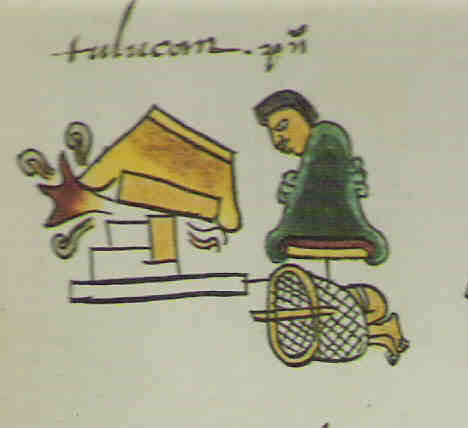
The depiction of the Aztec conquest of Toluca in the Codex Mendoza, showing the burning-temple glyph

A couple of ways of separating these hypotheses are to look at the timing of the burning, and the degree of primary refuse left behind (Cameron and Tomka 1993; Inomata and Webb 2003). First, do all of the burned structures date to a single phase? If they do, this would suggest that they were burned as part of an event affecting the whole site, such as the Aztec conquest or the Spanish congregación policy. In fact, the three most severely burned structures at the site (in Units 315, 316, and 317) each dates to a different phase, which means that house burning was an ongoing activity throughout the site’s history. Second, how cleaned out were the houses before they burned? If burning is a planned, scheduled activity (such as for pest control, or congregación), people have time to remove all of their things from the house beforehand and there won’t be many artifacts left on the floor. In contrast, if the burning is unexpected (such as for conquest, or an accidental fire), the contents of the house are likely to burn with it and many of them may not be salvageable after the fire. One of the things we noticed during excavation at Calixtlahuaca was how few artifacts were found on floors, or in other primary contexts. Compared to many other projects, we found few whole or reconstructable pots (only 32), and only one of those, Vessel 2, was found on a floor, rather than in a burial or broken in a trash pit. Taken together, these two lines of evidence would suggest intentional, regular, planning burning, likely by the occupants of the houses themselves.

Vessel 2, a locally-produced version of Aztec Orangeware, found on the floor of the house in Unit 309


References:

Cameron, Catherine M. and Steve A. Tomka (editors)
                1993       Abandonment of Settlement and Regions: Ethnoarchaeological and Archaeological Approaches. Cambridge University Press, New York.

Inomata, Takeshi and Ronald W. Webb
                2003       Archaeological Studies of Abandonment in Middle America. . In The Archaeology of Settlement Abandonment in Middle America, edited by T. Inomata and R. W. Webb, pp. 1-12. Foundations in Archaeological Inquiry, J. M. Skibo, general editor. The University of Utah Press, Salt Lake City.

Karabowicz, Amy
                2009       Wattle and Daub Architecture at Calixtlahuaca, Mexico: Experimental Analyses and a Comparative Study with Europe. Senior Honors Thesis, Barrett Honor's College, Arizona State University, Tempe, AZ.


Thursday, July 14, 2011

What happened to the people of Calixtlahuaca after the Spanish conquest?

Most Aztec-period cities and towns continued on as Spanish-colonial cities after the Spanish conquest of 1521. From Mexico City to Cuernavaca to Xochimilco to Texcoco, and many others, these towns were settled by Spaniards (sometimes only a few, sometimes many).. Christian churches were built and the towns flourished in the Colonial economy and on into modern times, where they still exist today.

But not Calixtlahuaca. This Matlatzinca city went from a populated urban center and political capital to an abandoned ruin within a few decades after the Spanish conquest. The city of Toluca, on the other hand, was either nothing or a small village in pre-Spanish times -- no credible archaeological site has been found for pre-Spanish Tollocan. But by the mid-1500s Toluca had a large Franciscan church and convent, and the city went on to become capital of the state of Mexico, and the country's fourth major industrial center today.

We know that the occupation of at least some of the houses at Calixtlahuaca continued for a couple of decades after 1521, because we find ceramic figurines with Spaniards in Spanish dress and poses (see photo). These are in the final occupation layers  of the site. But we don't think the occupation continued much beyond a few decades, because we did not find colonial middens with cow and horse bones, glazed ceramics, iron nails, etc. This lack of 16th century colonial debris is not a definitive indication of abandonment, however. In the Teotihuacan Valley, Tom Charlton reported years ago that rural Aztec villages continued functioning for up to a century after 1521 without obvious colonial material remains like these. But Calixtlahuaca was not a rural village - it was the most powerful capital between Tenochtitlan and the Tarascan Empire. So if it HAD continued to be occupied, we would expect to find things like: (1) a sixteenth century church; (2) these kinds of Spanish colonial artifacts.

So, what happened? Most likely, the residents of the city were forcibly moved into Toluca. The Spanish authorities instituted a practiced called "congregación" in which they moved native peoples into towns and cities (the better to control them, to con vert them, and to tax them). Many of the congregaciones left evidence in Spanish official archives, but any documents describing a congregación to Toluca have unfortunately not survived (Jarquin 1994).

But the abandonment of Calixtlahuaca is likely, given that in 1561, the Spanish crown granted land to found the village of San Francisco Calixtlahuaca, which was the origin of the modern town of the same name. I looked at the official decree today in the Archivo General Agrario in Mexico City. The text is accompanied by a crude map, showing the lands granted to the new town. Not being a paleographer, I had trouble reading the sixteenth century handwriting. There is a brief description in a catalog of the archive, however (Olmedo 1998:84).  If the residents of Calixtlahuaca had kept living at the site, or if they had moved down off the hill to the site of the historical town, one would not think that the crown would issue a decree founding the town.

This area was part of the "Marquesado del Valle" estate of the conqueror Hernando Cortés. Soon after 1521 he started raising cattle and pigs in the vicinity of Calixtlahuaca, and the new town in 1561 was probably populated by his employees or subjects.

The main church in San Francisco Calixtlahuaca today dates to the nineteenth century. But the small church at the cemetery, just outside of town, is much older. Perhaps this was the main church from the sixteenth century, or perhaps an older church was torn down to build the modern one. The cemetery church has a fascinating carved stone relief embedded in its wall. This drawing is by Hanns Prem from 1970 (see Prem 1980).. The relief shows the Christian date at top "1563 año", and the date for that year in the Aztec calendar at the bottom (6 Reed). We have no idea whether this relief is from the village or from another place entirely. It would be fascinating if 2years after the founding of the new colonial town, someone put up a carving in both the Spanish and Aztec calendars. By the 1700s, there were at least some Nahuatl speakers in San Francisco Calixtlahuaca, as evidenced by a will published by Caterina Pizzigoni (2007).

This model is still somewhat speculative. We would love to have more data on what happened to all those people in the early to mid sixteenth century. According to published catalog, the Archivo General Agrario supposedly has another map and document from San Francisco Calixtlahuaca, from 1575 (Esparza et al. 2000:160-161), but they could not find it at the archive today (even when I showed them the published catalog entry). Maybe we will find additional sixteenth century documentation. But for now, the outline sketched above makes sense out of both the archaeological and the historical data.

Two years ago, the newspaper Milenio published a nice article on Calixtlahuaca and our project. It was called "Calixtlahuaca: La nostalgia del poder," referring to the fact that the positions of Calixtlahuaca and Toluca were reversed during the colonial period. Before 1521, Calixtlahuaca was a big capital city and Tollocan (if it existed at all) was a small village. Today, Toluca is the state capital, and Calixtlahuaca just a village. But that village has some great ruins (our site!) and the big city has none.

References

Esparza, René, Rita Reséndez, and Arnulfo Embriz Osorio (editors)
    2000    Catálogo de mapas, planos, croquis e ilustraciones históricas de restitución y dotación de tierras y ampliación de ejidos del Archivo General Agrario. CIESAS, Mexico City.

Jarquín Ortega, María Teresa
    1994    Congregaciones de pueblos en el Estado de México. Colegio Mexiquense, Toluca.

Olmedo Gaxiola, Regina (editor)
    1998    Catálogo de documentos históricos del Archivo General Agrario. CIESAS, Mexico City.

Pizzigoni, Caterina
    2007    Testaments of Toluca. UCLA Latin American Studies, vol. 90. Stanford University Press, Stanford.

Prem, Hanns J.
    1980    Chronolgische Miszellen I. Mexicon 2(2):20-21.

*** Check out Wide Urban World for a post on Calixtlahuaca ***

Thursday, December 10, 2009

What language was spoken at Calixtlahuaca?

I seem to get asked this question quite a bit. People want to know how to label the people who built and lived in the city of Calixtlahuaca. During the excavations, a group of people from the group "Unión de los Pueblos del Valle de Toluca" visited us and asked if we knew which language was spoken. They represented indigenous people from the western part of the State of Mexico, including speakers of the Mazahua, Matlatzinca, and Otomi languages. It turns out that these three languages, plus Nahuatl, were all present in the Toluca Valley at the time of the Spanish conquest. Here is René García Castro's map of the non-Nahuatl language distribution at that time.
Calixtlahuaca is just above Toluca. It is within the area of Matlatzinca, near its northern border, and also within the area of Otomi (near its southern border). The Mazahua area is not far to the northwest. And we know that Nahuatl was spoken in much of the valley also.

It seems that we cannot answer this question about languages on the basis of present data. My guess is that the city was founded by non-Nahuatl speakers, but by the time the Mexica king Axayacatl conquered the city in the 1470s, there were speakers of all four languages. But that is mostly a guess. Perhaps better data from historical linguistics could help provide a more precise answer. Perhaps if we had better information on the Calixtlahuaca bird, we might be able to narrow down the choice of languages, at least for the ruling dynasty.

This lack of precision is frustrating, but it does not both me unduly. The language(s) spoken and ethnic identity of the inhabitants of Calixtlahuaca are less interesting to me than are their activities and accomplishments.

The map shown above is from García Castro (2000); see his 1999 book for documentation.

García Castro, René
1999 Indios, territorio y poder en la provincia matlatzinca: la negociación del espacio político de los pueblos otomianos, siglos XV-XII. CIESAS, Instituto Nacional de Antropología e Historia, and El Colegio Mexiquense, Mexico City and Toluca.

García Castro, René
2000 Los grupos indígenas del valle de Toluca. Arqueología Mexicana 43:50-55.