Friday, July 18, 2008

10,182 potsherds

Sorry if I'm still obsessing about this one ceramic collection, but in its size, good preservation, and diversity it tops any single sherd collection I've ever worked on. These piles of sherds on a lab table (probably 700 or so) are JUST THE DECORATED SHERDS from our big midden. This is somewhere near the total size of an average sherd collection.

The next photo shows a couple of piles of sherds by type (Red rim bowls o the left, and polished red, type B-0, on the right). The classification of these sherds is done by our excellent sherd wizards. These women, from the village of San Francisco Calixtlahuaca, started off last year washing sherds and other artifacts as they came in from the excavations. Our lab director, Cindy, had the women start working on some classification and cataloging in addition to the washing, so we hired them again this year, and they are doing a great job.

Here is another photo, with all four included this time. It took all week to get this level done, and we can now move on to a few of the other one thousand or so collections that need to be sorted.

Wednesday, July 16, 2008

Weirdest Object for this Season

What the heck is this thing? Please let me know if you have any ideas!!!

This is a partial ceramic object formed of a circular flat base with two small parallel linear projections, and three arms rising up at an angle. The arm on the left actually fits onto the base; the other two arms are just for illustrative purposes (there were clearly three arms).

We had the circular bases and arms classified in two different types (see photo 2). The bases were called "unidentified objects" and the arms were in the category "scored censers." It wasn't until Dorothy Hosler, our metallurgy expert, was puzzling over the circular objects and asking what kind of projections they had, that I thought to pull out some "handles" from the box of scored censers. Lo and behold, one of the arms fit right onto one of the bases (photo 3).

This thing is made of coarse paste with a crudely smoothed surface. Most pieces are heavily burned in an uneven fashion, suggesting that fire may have been involved in their use. The "tops" of the bases (with the two parallel projections) are more extensively burned than their bottoms.

The "tops" of the arms are all broken (photos 1 and 4). They are about 12 cm in length, after which they begin to curve inward. We have no idea how this thing looked in its upper part, but it seems logical to assume that the three arms were connected in some fashion.

The arms have crude deep irregular incisions on their top side (photo 4). These incisions were the justification for including the arms with our ceramic type "scored censers." This is a poorly understood low-frequency Aztec type made out of friable ware, and few if any whole vessels have survived. Now it is entirely possible that some or all of the "body sherds" of the scored censers type actually were part of the tops of these odd forms. We have tried refitting lots of sherds, but no luck yet.

So was this a stand for an ancient fondue pot? Was it a ritual object (always a good fall-back when considering an odd artifact). Or was it used in some kind of industrial activity? The crude nature of the ceramic material and finish, coupled with the extensive burning, suggest the latter possibility.

One reason for my ignorance about this (and many other fragmentary ceramic things) is that Aztec ceramic objects are poorly published. I discuss this broader issue in my Publishing Archaeology blog; see also my 2004 paper, Aztec Materials in Museum Collections: Some Frustrations of a Field Archaeologist, in the Nahua Newsletter.

So if you have any idea what this thing may have been used for, please post a comment, or better still, email me.

Tuesday, July 15, 2008

Ten thousand potsherds


The richest deposit we excavated at Calixtlahuaca was a trash pit behind a small house in unit 307. As noted in the blog last year, we recovered 34 bags of sherds from a single 10 cm excavated level. When they were washed and counted, there were 10,323 sherds in those 34 bags. The density of sherds was 22,550 sherds per cubic meter, a record by far for any of my excavations. Well, we now have those 10,323 sherds dumped out on a table, where they are being sorted into types by our able sherd workers from Calixtlahuaca: Judith Peralta Ortiz, Delfina Jaime Urbina, Janeth Gutiérrez Peralta, and Julia Peralta Ortiz (who is missing from the photo).

In any domestic ceramic collection, the single biggest category is the plain jars (see photo). We haven't finished counting these yet, but they probably comprise half or more of the total collection. Much more useful for the project, however, are the decorated bowls. We have a whole tub full of these sherds from this level. We like these not just because they are attractive and more interesting visually than plain jar sherds. They are useful for dating purposes (ceramic types and styles change through time), and they help us reconstruct patterns of trade (since some of the decorated types were imported from other areas).

This rich domestic trash midden will be extremely useful for the project goals. Trash is good for reconstructing domestic activities and conditions (what did they eat? where did they get their dishes? what kinds of ritual or craft activities took place in and around the hosue?). And more trash is better than less trash. Also, this trash pit showed some stratigraphic changes, with a thin deposit at the base that may date to the Middle Postclassic period, a thick batch of Late Postclassic materials (including this one level), and then a very early Spanish colonial layer at the top (See Spaniards in hats).

We know that this was a special deposit when Marieke Joel posed with her 34 bags of sherds last year. But now that we are getting into the collection, it is turning out to be an especially important deposit. We classified all of the other levels from the trash pit earlier this season, but we left this one for last, afraid of its enormous size. But the time spent classifying all those sherds will be well rewarded when we get to analyzing the results.

Sunday, June 22, 2008

Terraced Hill Cities in Postclassic Codices


Calixtlahuaca covered the top and most of the slopes of Cerro Tenismo (see photo). There were a number of other terrace hill cities in ancient Mesoamerica. The best known are from the Classic and Epiclassic periods: Monte Alban and Xochicalco. Both were large complex cities with abundant public architecture on top of the hill and residential areas on terraces on the hillslopes. The site of El Palmillo in Oaxaca has less spectacular public architecture, but the residential preservation is good and recent fieldwork by Gary Feinman and Linda Nicholas is providing important new information (Feinman, and Nicholas 2004; Feinman, et al. 2002; Feinman, et al. 2006).

The terraced hill cities of the Late Postclassic period are less well known, but this was a major settlement type. Just 15 km south of Calixtlahuaca is Tlacotepec, another Postclassic terraced hill city. It was damaged severely by Frederick Starr by his “excavations” around 1900, and today we know little about the site beyond the several thousand objects that Starr sold to the Field Museum of Natural History (McVicker 1992).
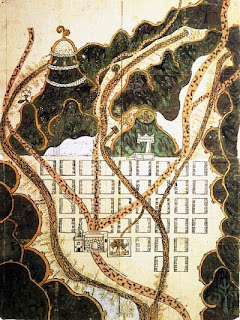
There are a number of representations of terraced hill cities in the codices. One such image from a Cuicatec codex, the Códice Fernéndez Leal (f. 13-14), is shown here (van Doesburg 2001: v.2, f.13-14). There is a battle in progress, with warriors standing on all of the terraces and fending off attackers at the base. Another Oaxacan example (see photo) is from the Relación Geográfica of Texupan (Acuña 1984-88: v.2, p222). The terraced site, on a hill looming above the Spanish colonial town, may have been the Postclassic citey of Texupan.

One final example is provided in the Historia Tolteca-Chichimeca (Kirchhoff, et al. 1976:f. 42v), which is also the scene of a battle. The fact that two out of three codex images show battles suggests that military defense may have been important in the decision to build cities on hills in the Postclassic period. This is the interpretation of Gerardo Gutiérrez, whose 2005 article pointed me toward these images (Gutiérrez 2005).

For Calixtlahuaca, however, the defensive argument has less to support it. It is always difficult to argue from archaeological remains whether features such as city walls were built for defense or for symbolic reasons (there is a big literature on this, I won’t cite sources here). At Calixtlahuaca, two public buildings were built on the flat land at the base of the hill—the royal palace and a ceremonial platform that may have been a ballcourt. If defense were of paramount importance in the design of the site, one would expect that the royal palace would be built on the slopes, or perhaps on top of the cerro.

As far as we can tell from the native historical sources, Calixtlahuaca had no rivals as a political capital early in its history (this is from a paper by Brian Tomaszewski and me that is now in preparation), so perhaps its rulers did not worry about defense in laying out their city. But had they thought more of defense, perhaps they could have held off Axayacatl and the invading Mexica army a bit longer in the 1470s.

I wish someone would write a paper synthesizing what we know about terraced hill cities in Postclassic Mesoamerica.

REFERENCES:

Acuña, René (1984-88) Relaciones geográficas del siglo XVI. 10 vols. Universidad Nacional Autónoma de México, Mexico City.

Feinman, Gary M. and Linda M. Nicholas (2004) Hilltop Terrace Sites of Oaxaca, Mexico: Intensive Surface Survey at Guirún, El Palmillo, and the Mitla Fortress. Fieldiana, Anthropology vol. 37. Field Museum of Natural History, Chicago.

Feinman, Gary M., Linda M. Nicholas and Helen R. Haines (2002) Houses on a Hill: Classic Period Domestic Life at El Palmillo, Oaxaca, Mexico. Latin American Antiquity 13:251-278.

Feinman, Gary M., Linda M. Nicholas and Helen R. Haines (2006) Socioeconomic Inequality and the Consumption of Chipped Stone at El Palmillo, Oaxaca, Mexico. Latin American Antiquity 17:151-176.

Gutiérrez, Gerardo (2005) Jardines defensivos: un acercamiento histórica-arqueológico al use de la vegetación en la guerra antigua. Anales de Antropología 39(1):51-78.

Kirchhoff, Paul, Lina Odena Güemes and Luis Reyes García (editors) (1976) Historia tolteca-chichimeca. Instituto Nacional de Antropología e Historia, Mexico City.

McVicker, Donald (1992) México: La Visión del Cosmos: Three Thousand Years of Creativity. The Mexican Fine Arts Center Museum, Chicago.

van Doesburg, Sebastian (2001) Códices Cuicatecos Porfirio Díaz y Fernández Leal. 2 vols. Grupo Editorial Miguel Angel Porrúa, Mexico City.

Tuesday, June 17, 2008

The Calixtlahuaca Chronology, part 1

Most of our work in the lab this summer focuses on two themes: processing various miscellaneous artifact categories, and working on chronology. Many people think that archaeological chronology is boring, and they are probably right. But if archaeologists can’t get our time sequence straight, it’s hard to say much that is interesting about events and processes in the past. Perhaps due to some strange mental defect, I happen to think chronology is interesting and even fun (sometimes). I’ve developed a number of Postclassic chronologies in the state of Morelos; each region has needed its own sequence (Hare, and Smith 1996; Smith, and Doershuk 1991). I’ve also written on theoretical aspects of archaeological chronology (Smith 1992), arguing that the degree of effort archaeologists need to invest in chronology is related to the kinds of ancient processes they want to study.

At Calixtlahuaca, we want to know how the site was founded and grew through time, and we would like to be able to tell apart the periods before and after the site was conquered by the Triple Alliance (Aztec) Empire. This will require a relatively fine-grained chronology, comparable to those I worked out for parts of Morelos. We will use three basic ingredients for the task: radiocarbon dates, stratigraphy, and ceramics. Most of our time in the lab right now is dedicated to ceramic classification, focusing this year on contexts that will help us establish the chronology and assign dates to structures and deposits. More about this later.

Last winter we ran the first batch of C14 dates for Calixtlahuaca. The results are shown in the accompanying figure. Each horizontal line with blobs is a calibrated date. I won’t explain calibration here; there are good web pages on calibration. The important fact is that each “date” is in reality a range of probabilities, shown by the blobs in a calibration chart like this. Due to the peculiarity (perversity?) of the atmospheric carbon during Postclassic times, the calibration curve fluctuates, so that for many dates there are two different ranges of years that could represent the true age of the sample. This makes it difficult to figure out just how old some of the samples really are.

Most of our dates fall into the interval of the Late Postclassic (or Late Aztec) period (ca. AD 1300-1520, green and red on the chart). This is not surprising; our initial hypothesis, based on ceramics from García Payón’s collections and our 2006 survey, was that most of the occupation at the site was from the Late Postclassic period. We have several dates from the Middle Postclassic (or Early Aztec) period (ca. AD 1100-1300), again not surprising. Most Aztec-period urban sites were occupied in both periods (Smith 2008), with growth and expansion in the later period. The earliest dates may extend back into the Early Postclassic (or Toltec) period, AD 900-1100; to me this suggests that the Middle Postclassic occupation may have begun prior to 1100. There are few or no Early Postclassic ceramics at the site.

Unfortunately none of these dates (except possibly the bottom two) fall clearly into the second half of the Late Postclassic period (the red zone on the chart). This corresponds to the period after the Aztec conquest of the Toluca Valley. The most likely explanation is that we simply did not happen to submit carbon samples from occupations of this time period, and this will be a priority when we submit our next batch of samples. We are beginning to see some ceramic patterns in the lab that suggest that we will be able to isolate this late portion of the Late Postclassic with ceramics.

Now, an important caveat: THESE RADIOCARBON DATES PROVIDE ONLY A VERY PROVISIONAL PICTURE OF THE DATING OF THE SITE! We have a few deposits dated by 2 or more dates, but most of the dates are from a single carbon sample from an individual context. An old saying in the carbon dating world is that “One date is no date” (Aitken 1990:95). The reason for this derives from the fact that C14 dates are really probability distributions (the blobs), not single points in time. When one gets multiple dates from a single context and most of them agree, then the context is dated much more securely (and much more precisely). So until we get more dates, this is an initial look at the chronology of our deposits.

References Cited:

· Aitken, M. J. (1990) Science-Based Dating in Archaeology. Longman, New York.

· Hare, Timothy S. and Michael E. Smith (1996) A New Postclassic Chronology for Yautepec, Morelos. Ancient Mesoamerica 7:281-297.

· Smith, Michael E. (1992) Braudel's Temporal Rhythms and Chronology Theory in Archaeology. In Annales, Archaeology, and Ethnohistory, edited by A. Bernard Knapp, pp. 23-34. Cambridge University Press, New York.

· Smith, Michael E. (2008) Aztec City-State Capitals. University Press of Florida, Gainesville.

· Smith, Michael E. and John F. Doershuk (1991) Late Postclassic Chronology in Western Morelos, Mexico. Latin American Antiquity 2:291-310.

My articles are posted here.

Tuesday, June 10, 2008

Can we call Calixtlahuaca an “Aztec” city?


Well, look what site is featured on the cover of the newly released book, Aztec City-State Capitals! This book cover proves that Calixtlahuaca was indeed an Aztec city.

To get serious now, the answer to the above question depends, of course, on one’s definition of the term Aztec. Although there are a few limited uses of “Azteca” in native sources, the term is basically a modern label, so scholars have been free to use it as they please. Some writers use “Aztec” to refer to just the Mexica peoples who inhabited the imperial capital, Tenochtitlan. This does not make sense to me, because the terms “Mexica” or “Tenochca” are indigenous terms that work just fine for that category of people. Others use Aztec for all of the Nahuatl-speaking peoples of the Valley of Mexico, but I tend to use the term Aztec to refer to all of the people living in highland central Mexico on the eve of the Spanish conquest (see The Aztecs, 2nd edition, 2003, Blackwell, chapter 1). There is no clear indigenous word for this category of people, but it is an important grouping in terms of social, economic, political, and religious dynamics.

Furthermore, this category of people—including mostly Nahuatl speakers but also significant numbers of speakers of Otomi and other Oto-Pamean languages—has a certain unity in terms of material culture. Each region (such as the area around Calixtlahuaca) had its own ceramic types and styles, but the Aztecs as defined above shared a number of ceramic traits. Also, a basic Aztec style of architecture was found throughout this area. And that is the subject of my new book (which, by the way, I have yet to see, even though my wife informs me that ten copies from the publisher showed up in Arizona last week).

Calixtlahuaca was a provincial city, hardly given a second thought by most of the Aztecs who lived in the Valley of Mexico (and hardly given a second thought today by people who associate "Aztec" with the Valley of Mexico). Yet some of the finest and best preserved Aztec public buildings (Aztec in style and form) are found at Calixtlahuaca. The publisher, University Press of Florida, initially wanted to put an image of Tenochtitlan on the book cover, but this goes against my informal alternative title for the book: “All the Aztec Cities Except for Tenochtitlan.” Besides, José Luis de Rojas is writing a book on Tenochtitlan for the same book series, Ancient Cities of the New World. So I sent them the photo of structure 3 at Calixtlahuaca, and voilá.

So my answer to the above question is yes, Calixtlahuaca was an Aztec city. But if someone wants to claim that it was a Matlatzinca city, that is also correct. The city was called Matlatzinco and it was the capital of a large territorial state also known as Matlatzinco, and some of its inhabitants probably spoke the language known today as Matlatzinca.

You can buy the book at the University Press of Florida.

Saturday, May 31, 2008

The Calixtlahuaca Project is Back

Well, the Calixtlahuaca Archaeological Project didn’t leave, so how can we come back? It is the blog that is back, after months of little activity. During the 2007-08 academic year the project moved forward in a number of areas, mostly research by students and faculty at Arizona State University. Now we are back in Mexico, working on the artifacts in our nice new lab facility at the Colegio Mexiquense in Zinacantepec (outside of Toluca, State of Mexico). I’ll try to post more often to describe what we are doing and what we are leaning.

In this post and perhaps one or more to follow, I’ll outline what we have been up to since fieldwork ended in July, 2007. Activities included the following:

  • I had to move my office and lab at ASU upon returning from Mexico. This caused all sorts of chaos and delays.
  • We ran twenty radiocarbon dates at the University of Arizona AMS dating lab. This is a first set of dates; more will follow if and when I get a grant for analysis. Nearly all of the dates fall into a Middle to Late Postclassic time span (ca AD 1100-1520). A couple of them could extend into Early Postclassic times (AD 900-1100) and a couple could extend into the early colonial period (AD 1520 -1650). We need to run more dates and do comparative ceramic and stratigraphic analysis to refine the chronology, but basically the dates confirm my impression that all or nearly all of the occupation of Calixtlahuaca was during the Middle to Late Postclassic period (in other words, the Aztec period).
  • We worked on field notes, drawings, databases, photo catalogs, and other exciting stuff.
  • We worked on technical reports, also an exciting development.
  • We began making plans for a series of technical analyses of artifacts and data, to be included in a new grant proposal to the National Science Foundation.
  • A number of students gave papers and posters at the 2008 SAA meetings in Vancouver. The project had a very good presence at the meetings:
    • Brown, Timothy and Mellissa Ruiz (2008) Calixtlahuaca, Mexico,2007 Field Season: Preliminary Excavation Results. Poster presented at the 2008 Annual Meeting, Society for American Archaeology.
    • Guthrie, Caitlin (2008) The Censers of Calixtlahuaca. Poster presented at the 2008 Annual Meeting, Society for American Archaeology.
    • Huster, Angela (2008) Scraping and Spinning: Maguey Fiber Production at Calixtlahuaca, Mexico. Paper presented at the 2008 Annual Meeting, Society for American Archaeology.
    • Novic, Juliana (2008) Reaching the City Limits: Identifying Settlement Boundaries at Calixtlahuaca, Toluca, Mexico. Poster presented at the 2008 Annual Meeting, Society for American Archaeology.
  • I gave lectures on the project at various places, including the University of Colorado, and University of Connecticut, the Colegio Mexiquense, and ASU.
  • Emily Umberger continued work on the sculptures, documenting a new regional political art style in the reliefs that José García Payón excavated at Calixtlahuaca. Some of her preliminary findings are presented in:
    • Umberger, Emily (2007) Historia del arte e Imperio Azteca: la evidencia de las esculturas. Revista Española de Antropología Americana 37:165-202.
  • I completed the proofing and indexing for my new book, which has some limited information from the Calixtlahuaca Archaeological Project:

Now it’s back to potsherds and burnt daub. Stay tuned for more results.

But first, the question everybody wants answered: NO, we did NOT find any crystal skulls at Calixtlahuaca.

Saturday, August 11, 2007

Aztec Royal Tomb


Last fall, archaeologists working near the Aztec Templo Mayor in Mexico City uncovered a huge carved stone monument with an image of Tlaltecuhtli, the earth god. Last week they scanned the area with ground-penetrating radar, which revealed several hollow chambers under the monolith. A date on the monument -- 10 rabbit -- corresponds to AD 1502, the date the emperor Ahuitzotl died. This could the tomb of Ahuitzotl, which would be a major find because no royal Aztec burials have been located previously.

You can listen to me talking about this on National Geographic News for August 10, 2007, on the NSG website (click on news for August 10; the interview starts about 7:30 into the show).

http://www.nationalgeographic.com/podcasts/ngnews.html

How is this relevant to Calixtlahuaca? Well, I was interviewed for an AP story about this by cell phone while supervising excavations high on the hill at Calixtlahuaca:

http://news.yahoo.com/s/ap/20070803/ap_on_re_la_am_ca/mexico_aztec_tomb

Also, it was Ahuitzotl's brother, the former emperor Axayacatl, who conquered Calixtlhahuaca for the Mexicca around 1475.

Now we have to wait for archaeologists to remove the huge (broken) monolith to see what is in the hollow chambers....

Wednesday, July 25, 2007

The 2007 Season is Done


I have been too busy to post to the blog for a while. We finished fieldwork in early July. As typically happens, we found all sorts of interesting (and time-consuming) things the final weeks of fieldwork. We excavated three burials the final couple of weeks, two with ceramic vessels as offerings, one without. We found a buried burned house with a collapsed burned daub wall covering 20 cm of charcoal—burned seeds, wood, and other plant material. In that excavation (unit 323), a trench just clipped the edge of the feature in the final days of fieldwork, so we were only able to excavate part of it. In a trench designed to document the stratigraphy of an agricultural terrace we found a nice stone pavement, with a dense midden deposit underneath.

All this activity, plus other issues of closing down fieldwork, have given me little time for the blog (but then how I find time to start a new blog for professionals and grad students called “Publishing Archaeology”? http://publishingarchaeology.blogspot.com/ I will quote Walt Whitman: “ Do I contradict myself? Very well, then I contradict myself. I am large, I contain multitudes.”).

We have moved our entire lab to the Colegio Mexiquense in nearby Zinacantepec, where we will be analyzing artifacts for the next few summers. Just a few closing facts, things that came up in the final weeks of the season. Our total of burned daub is over 500 kilograms (half a metric ton). What are we going to do with all this? Stay tuned. I will keep this blog open to report various project results as they become available and as I have time to report. Also on the daub, we have found that many of the wood house supports were made of maguey stalks (the impressions on freshly-cut maguey stalks match rather precisely the impressions on the burned daub).

The last task given to our excellent crew of local lab workers was to catalog the sherd disks. They spent over a day at it, and had to stop when we came to move the tables and chairs to the new lab. The catalog now includes over 1,600 sherd disks, and they still have about 25% of the collection to catalog.

I won’t be giving a paper on the excavations at the SAA meetings next year, because I was talked into giving a presentation on “Ancient cites: Do they hold lessons for the modern world.” It seems less important to report new fieldwork at the archaeology meetings now, since things can be posted so easily on the internet. Between this blog and more formal project reports and data on the project web site, interested people can keep up with the project.

This has been an experiment for me. If you particularly like this blog, let me know. If you think it is stupid and pointless, then please keep your opinions to yourself! (I once got an email from a high school student telling me that “my so-called web site is a piece of sh—“. I think she needed information quickly for a report due the next day and my site didn’t have what she needed.)