Informal reports from current archaeological research at Calixtlahuaca. Calixtlahuaca was a large urban center of the Matlatzinco culture, closely related to the Aztecs.
Wednesday, December 5, 2012
Imported Ceramics, or the Lack Thereof
Monday, May 7, 2012
2012 and the End of the World
Nice comic from Bizarro last week. It is incredibly ironic that the Mayas did NOT predict the end of the world (in 2012 or any other time) and they get all the publicity, while the Aztecs DID predict the end of the world and no one pays any attention! Well, maybe in 2027 we will get some mileage out of the Aztec prediction.
See my earlier post on Publishing Archaeology about the bogus 2012 predictions.
And this is another good one, widely reproduced by now:
For the ancient residents of Calixtlahuaca, the end of the world came in the 16th century. Once Tenochtitlan fell to Cortés, it wasn't long before smallpox and other diseases, coupled with forced evacuation to Toluca, brought the city of Calixtlahuaca to a halt.
Sunday, December 11, 2011
The Aztecs, 3rd edition
I managed to get a photo of Calixtlahuaca on the cover of my book, Aztec City-State Capitals (2008). For the new edition of The Aztecs, the cover shows the nice double-stair pyramid of Teopanzolco in Cuernavaca.
Wednesday, January 5, 2011
The Aztecs of Calixtlahuaca
- Speakers of Nahuatl, as well as speakers of some Oto-Pamean languages
- People living in Tenochtitlan (the Mexica).
- People living in other places in the Valley of Mexico (there is no good indigenous term for these people).
- People living in the surrounding valleys (Morelos, Puebla, Tlaxcala, Toluca, etc.) who interacted heavily with those in the Valley of Mexico and shared many social and cultural trains with them.
I realize that some colleagues, who want to limit the term Aztec to the inhabitants of Tenochtitlan, will probably jump on me for my decision. But those of Tenochtitlan have TWO good names that they used themselves: Mexica, and Tenochca. But since the word "Aztec" was rarely used before the Spaniards arrived, and because there is no native term for the peoples of central Mexico at that time (although they clearly formed a significant social and cultural entity), and because no one has proposed a succinct alternative label, Aztec remains the term. Also, I doubt that Blackwell would want me to change the name of the book to "The peoples of central Mexico in the final centuries before AD 1519, including speakers and Nahuatl and other native languages."
Monday, August 31, 2009
Virtual tour of Malinalco

I have just seen a nice virtual tour of the site of Malinalco, on the INAH web site (thanks to Dave Grove for the suggestion).
Click here for the tour.
Malinalco was contemporaneous with Calixtlahuaca, and it is possible that it fell within the political domain of our site (prior to Axayacatl's conquests in the 1470s, that is).
This map is from my book, Aztec City-State Capitals, where I have a short discussion of Malinalco:
Thursday, August 20, 2009
Aztec pyramids on the Discovery Channel
The first two episodes of this series will air Monday, August 24, from 9:00-11:00 pm (EDT and PDT). My segment on Aztec pyramids will be in the second show.
Below is a view of the main double-stair pyramid at Tlatelolco, with a 16th century Christian Church and a 20th century apartment building in the background. (This is called the "Plaza of the Three Cultures"). For more information on Tlatelolco, see my book, Aztec City-State Capitals.
Monday, April 27, 2009
Wednesday, July 16, 2008
Weirdest Object for this Season
This is a partial ceramic object formed of a circular flat base with two small parallel linear projections, and three arms rising up at an angle. The arm on the left actually fits onto the base;
the other two arms are just for illustrative purposes (there were clearly three arms).We had the circular bases and arms classified in two different types (see photo 2). The bases were called "unidentified objects" and the arms were in the category "scored censers." It wasn't until Dorothy Hosler, our metallurgy expert, was puzzling over the circular objects and asking what kind of projections they had, that I thought to pull out some "handles" from the box of scored censers. Lo and behold, one of the arms fit right onto one of the bases (photo 3).
This thing is made of coarse paste with a crudely smoothed surfa
ce. Most pieces are heavily burned in an uneven fashion, suggesting that fire may have been involved in their use. The "tops" of the bases (with the two parallel projections) are more extensively burned than their bottoms.The "tops" of the arms are all broken (photos 1 and 4). They are about 12 cm in length, after which they begin to curve inward. We have no idea how this thing looked in its upper part, but it seems logical to assume that the three arms were connected in some fashion.
The arms have crude deep irregular incisions on their top side (photo 4). These incisions were the justification for including the arms with our ceramic type "scored censers." This is a poorly understood low-frequency Aztec type made out of friable ware, and few if any whole vessels
have survived. Now it is entirely possible that some or all of the "body sherds" of the scored censers type actually were part of the tops of these odd forms. We have tried refitting lots of sherds, but no luck yet.So was this a stand for an ancient fondue pot? Was it a ritual object (always a good fall-back when considering an odd artifact). Or was it used in some kind of industrial activity? The crude nature of the ceramic material and finish, coupled with the extensive burning, suggest the latter possibility.
One reason for my ignorance about this (and many other fragmentary ceramic things) is that Aztec ceramic objects are poorly published. I discuss this broader issue in my Publishing Archaeology blog; see also my 2004 paper, Aztec Materials in Museum Collections: Some Frustrations of a Field Archaeologist, in the Nahua Newsletter.
So if you have any idea what this thing may have been used for, please post a comment, or better still, email me.
Sunday, June 22, 2008
Terraced Hill Cities in Postclassic Codices

Calixtlahuaca covered the top and most of the slopes of Cerro Tenismo (see photo). There were a number of other terrace hill cities in ancient
The terraced hill cities of the Late Postclassic period are less well known, but this was a major settlement type. Just 15 km south of Calixtlahuaca is Tlacotepec, another Postclassic terraced hill city. It was damaged severely by Frederick Starr by his “excavations” around 1900, and today we know little about the site beyond the several thousand objects that Starr sold to the Field Museum of Natural History (McVicker 1992).
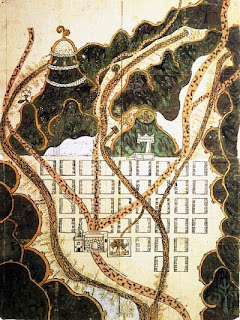
There are a number of representations of terraced hill cities in the codices. One such image from a Cuicatec codex, the Códice Fernéndez Leal (f. 13-14), is shown here (van Doesburg 2001: v.2, f.13-14). There is a battle in progress, with warriors standing on all of the terraces and fending off attackers at the base. Another Oaxacan example (see photo) is from the Relación Geográfica of Texupan (Acuña 1984-88: v.2, p222). The terraced site, on a hill looming above the Spanish colonial town, may have been the Postclassic citey of Texupan.
One final example is provided in the Historia Tolteca-Chichimeca (Kirchhoff, et al. 1976:f. 42v), which is also the scene of a battle. The fact that two out of three codex images show battles suggests that military defense may have been important in the decision to build cities on hills in the Postclassic period. This is the interpretation of Gerardo Gutiérrez, whose 2005 article pointed me toward these images (Gutiérrez 2005).
For Calixtlahuaca, however, the defensive argument has less to support it. It is always difficult to argue from archaeological remains whether features such as city walls were built for defense or for symbolic reasons (there is a big literature on this, I won’t cite sources here). At Calixtlahuaca, two public buildings were built on the flat land at the base of the hill—the royal palace and a ceremonial platform that may have been a ballcourt. If defense were of paramount importance in the design of the site, one would expect that the royal palace would be built on the slopes, or perhaps on top of the cerro.
As far as we can tell from the native historical sources, Calixtlahuaca had no rivals as a political capital early in its history (this is from a paper by Brian Tomaszewski and me that is now in preparation), so perhaps its rulers did not worry about defense in laying out their city. But had they thought more of defense, perhaps they could have held off Axayacatl and the invading Mexica army a bit longer in the 1470s.
I wish someone would write a paper synthesizing what we know about terraced hill cities in Postclassic Mesoamerica.
REFERENCES:
Acuña, René (1984-88) Relaciones geográficas del siglo XVI. 10 vols. Universidad Nacional Autónoma de México, Mexico City.
Feinman, Gary M. and Linda M. Nicholas (2004) Hilltop Terrace Sites of
Feinman, Gary M., Linda M. Nicholas and Helen R. Haines (2002) Houses on a Hill: Classic Period Domestic Life at
Feinman, Gary M., Linda M. Nicholas and Helen R. Haines (2006) Socioeconomic Inequality and the Consumption of Chipped Stone at
Gutiérrez, Gerardo (2005) Jardines defensivos: un acercamiento histórica-arqueológico al use de la vegetación en la guerra antigua. Anales de Antropología 39(1):51-78.
Kirchhoff, Paul, Lina Odena Güemes and Luis Reyes García (editors) (1976) Historia tolteca-chichimeca. Instituto Nacional de Antropología e Historia, Mexico City.
McVicker, Donald (1992) México: La Visión del Cosmos: Three Thousand Years of Creativity. The Mexican Fine Arts Center Museum, Chicago.
van Doesburg, Sebastian (2001) Códices Cuicatecos Porfirio Díaz y Fernández Leal. 2 vols. Grupo Editorial Miguel Angel Porrúa, Mexico City.
Tuesday, June 10, 2008
Can we call Calixtlahuaca an “Aztec” city?

To get serious now, the answer to the above question depends, of course, on one’s definition of the term Aztec. Although there are a few limited uses of “Azteca” in native sources, the term is basically a modern label, so scholars have been free to use it as they please. Some writers use “Aztec” to refer to just the Mexica peoples who inhabited the imperial capital,
Furthermore, this category of people—including mostly Nahuatl speakers but also significant numbers of speakers of Otomi and other Oto-Pamean languages—has a certain unity in terms of material culture. Each region (such as the area around Calixtlahuaca) had its own ceramic types and styles, but the Aztecs as defined above shared a number of ceramic traits. Also, a basic Aztec style of architecture was found throughout this area. And that is the subject of my new book (which, by the way, I have yet to see, even though my wife informs me that ten copies from the publisher showed up in
Calixtlahuaca was a provincial city, hardly given a second thought by most of the Aztecs who lived in the
So my answer to the above question is yes, Calixtlahuaca was an Aztec city. But if someone wants to claim that it was a Matlatzinca city, that is also correct. The city was called Matlatzinco and it was the capital of a large territorial state also known as Matlatzinco, and some of its inhabitants probably spoke the language known today as Matlatzinca.
You can buy the book at the University Press of Florida.
Friday, February 16, 2007
The excavations are started

We started digging a week ago. Our first task is to explore the area close to the royal palace (known locally as the "calmecac"). We are starting here becuase farmers will begin to prepare these fields for planting in March, and we want to be done before then. The photo shows some of the rooms in the palace.
This work has several goals: (1) to see if we can find any houses (elite or other) or other features in this area. In our 2006 survey and surface collections, we found very little evidence of occupation on the plain (where the palace is located); nearly all occupational debris was found on the slopes of Cerro Tenismo. Was the plain really empty or settlement (beyond the palace), or were there Postclassic occupations that are now deeply buried? (2) We are looking for possible refuse deposits from the palace. No one has excavated refuse from an Aztec royal palace. What did the royals eat for dinner? Did artists (sculptors, featherworkers, etc.) work at the palace? We know little about the lifestyles of the Aztec rich and famous, apart from what their descendents told the Spaniards after the Spanish conquest. Most archaeologists want more direct information on such topics, and data from the palace garbage heap will have less bias than the biased claims of colonial Aztec nobles. Finally, (3) We need to investigate the stratigraphy of the area. We located what appear to be intact Postclassic refuse deposits buried under a meter and more of dense clay. To someone used to finding Postclassic deposits in and just under the plow zone, this is quite a change. We are below the level of the palace, but not immediately next to it, so we now have to figure out if the clay (from a flood or colluvial event) was deposited before or after the construction of the palace.


